For the one you love
Tuned to preserve. Paired, the joint state leans toward whoever has less to give, so one heavy day holds the window for both. It protects the relationship before it suggests acting, and the wording stays warm.
Leans protective

An iPhone app that reads signals from smart wearables of two people and turns them into one joint readiness state.
01 / The state
Not your reading. Not theirs. One state computed from you both.
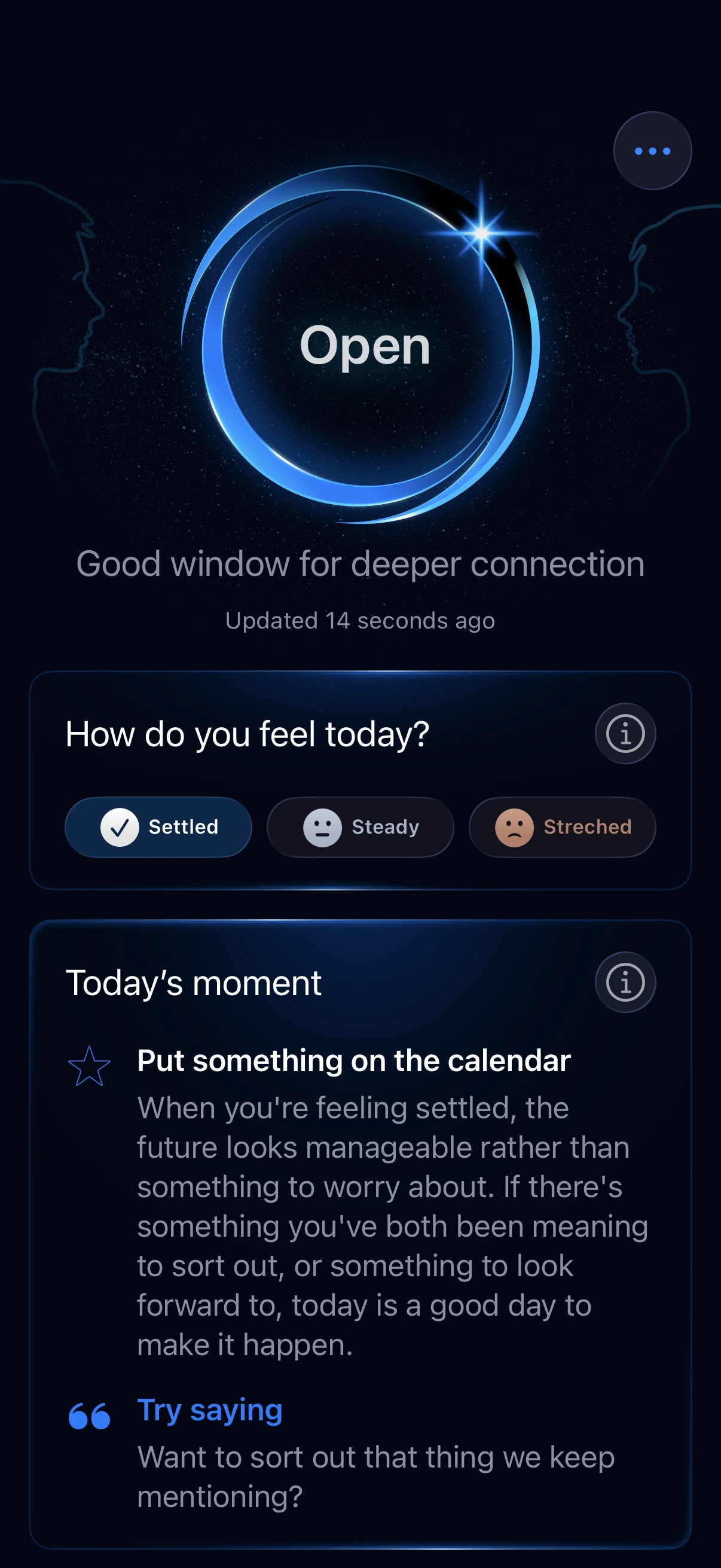


Say the hard thing
Good window for deeper connection
02 / The idea
The time you count
Calendars, deadlines, seconds. It passes whether or not you are ready. It never asks how you are.
The moment that counts
The opening for the words that matter. It does not appear on a calendar. It has to be recognised.
Some conversations fail not because of the words, but because of the when.
Your bodies already know the when. Kairos Next reads them both, and shows it to you as one joint readiness state.
03 / The model
Kairos Next combines several signals of autonomic and physical recovery. Each one is compared against your own long-term average, so you are measured against yourself and no one else. The morning read sets the foundation, when most signals are available. If your wearable tracks heart rate variability through the day, the state stays current. Your check-in can always realign it with how you actually feel.
Illustrative weighting. The exact mix shifts through the day and depends on data availability.
No wearable, or want a say? One tap, Settled, Steady or Stretched, either produces the read on its own or tilts it toward how you actually feel.
How often the window refreshes depends on your wearable. Apple Watch feeds it through the day. Others sync less often, and a self check-in works on its own.
04 / The pair
Just as good on your own
One shows a code. The other scans. From then on you both see the same thing: the joint state.
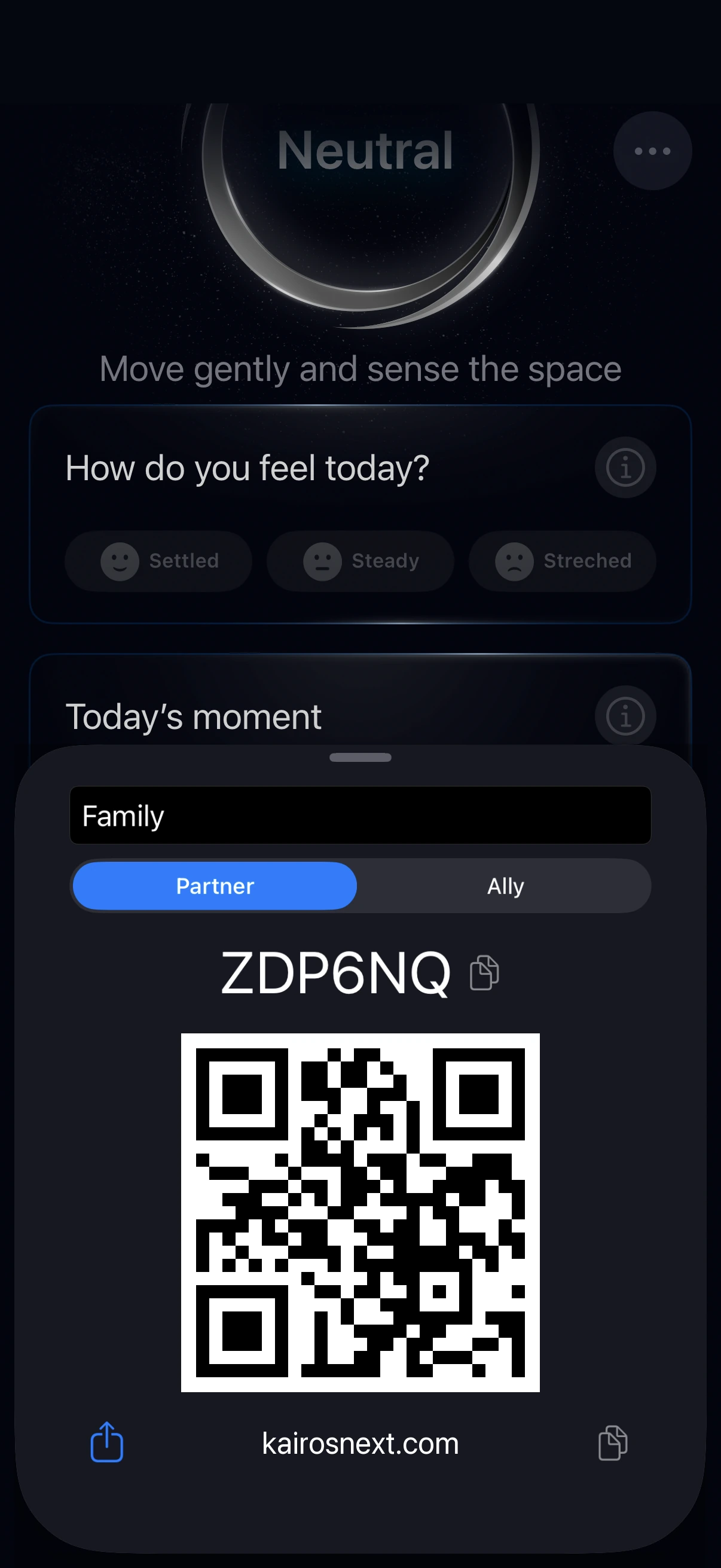
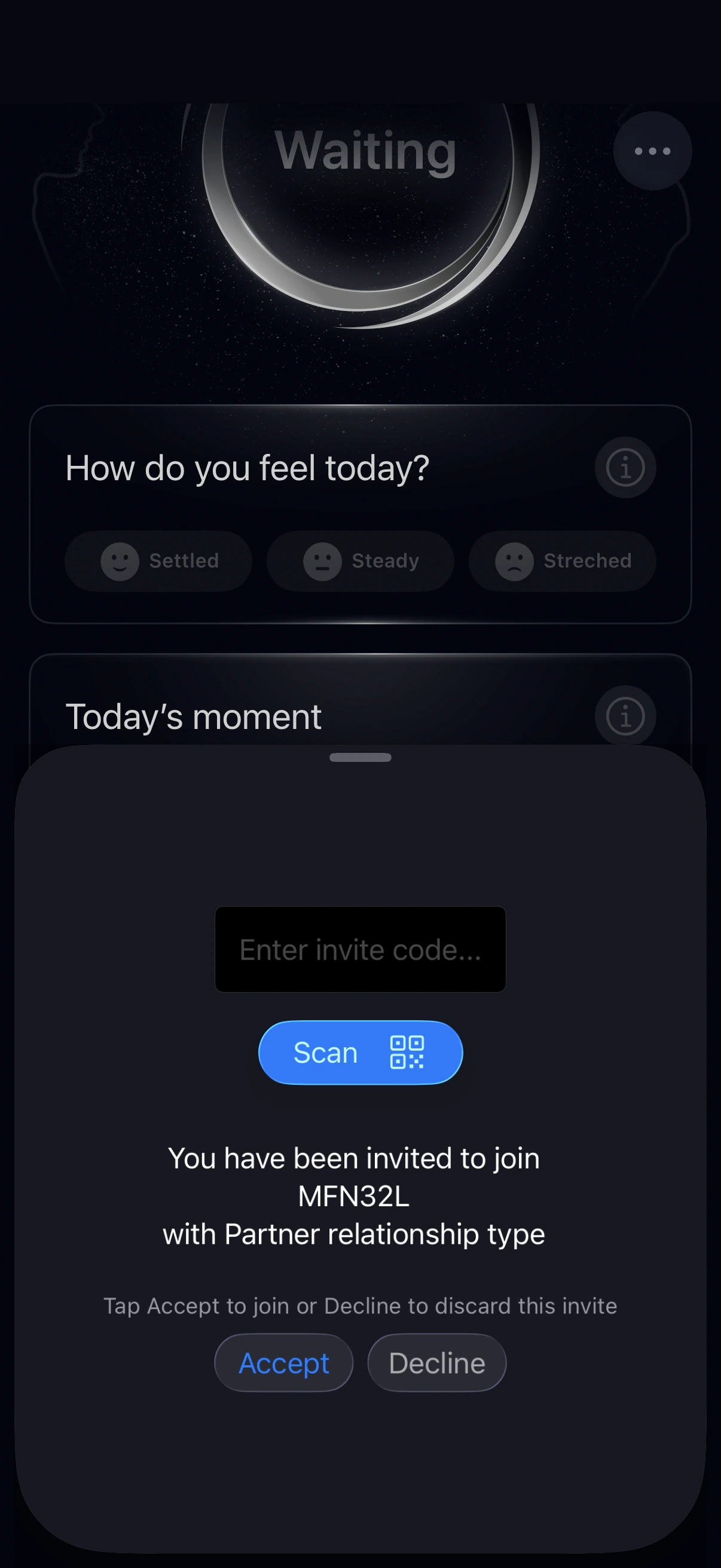
One QR code. No contacts, no invites, no accounts.
Signals never leave each phone. Only a derived value moves.
One joint state comes back. Same screen on both sides.
You never see their data. They never see yours. You both see the joint state
The same four signals, read the same way. Three things change: the thresholds, how the joint state is weighted when you are paired, and the wording you see.
Tuned to preserve. Paired, the joint state leans toward whoever has less to give, so one heavy day holds the window for both. It protects the relationship before it suggests acting, and the wording stays warm.
Leans protectiveTuned for capacity. The thresholds lean toward Open, because building together can take more push than intimacy can. The same model with a different threshold, leaning toward Open.
Leans OpenKairos Next for one, no pair required. It can use either the Partner or the Ally thresholds, and reads your own state through the day.
Works in both modes05 / Inside the app
The ring is the whole report. One glance, and you both know where you stand.
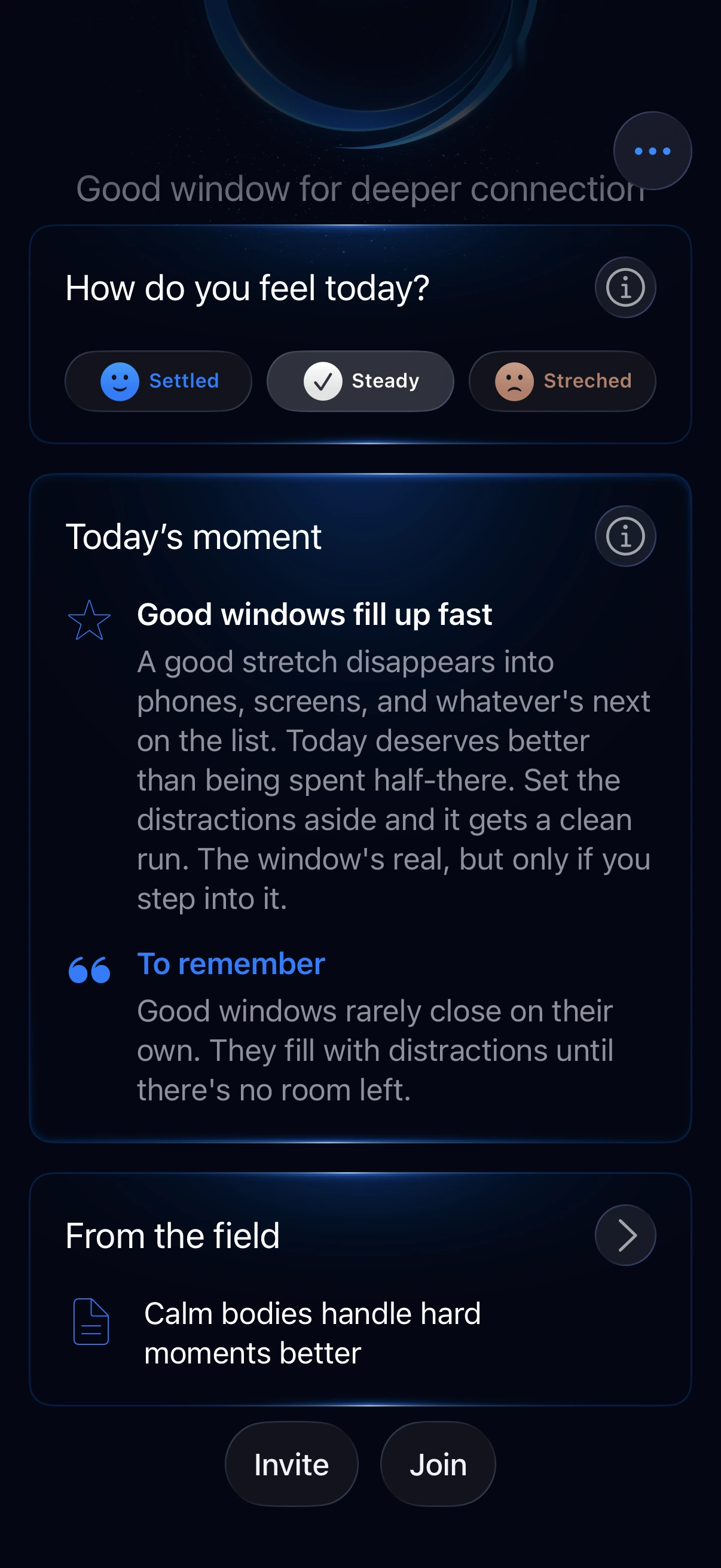
One short observation on the joint state, and how to make good use of it. It updates when the state changes.
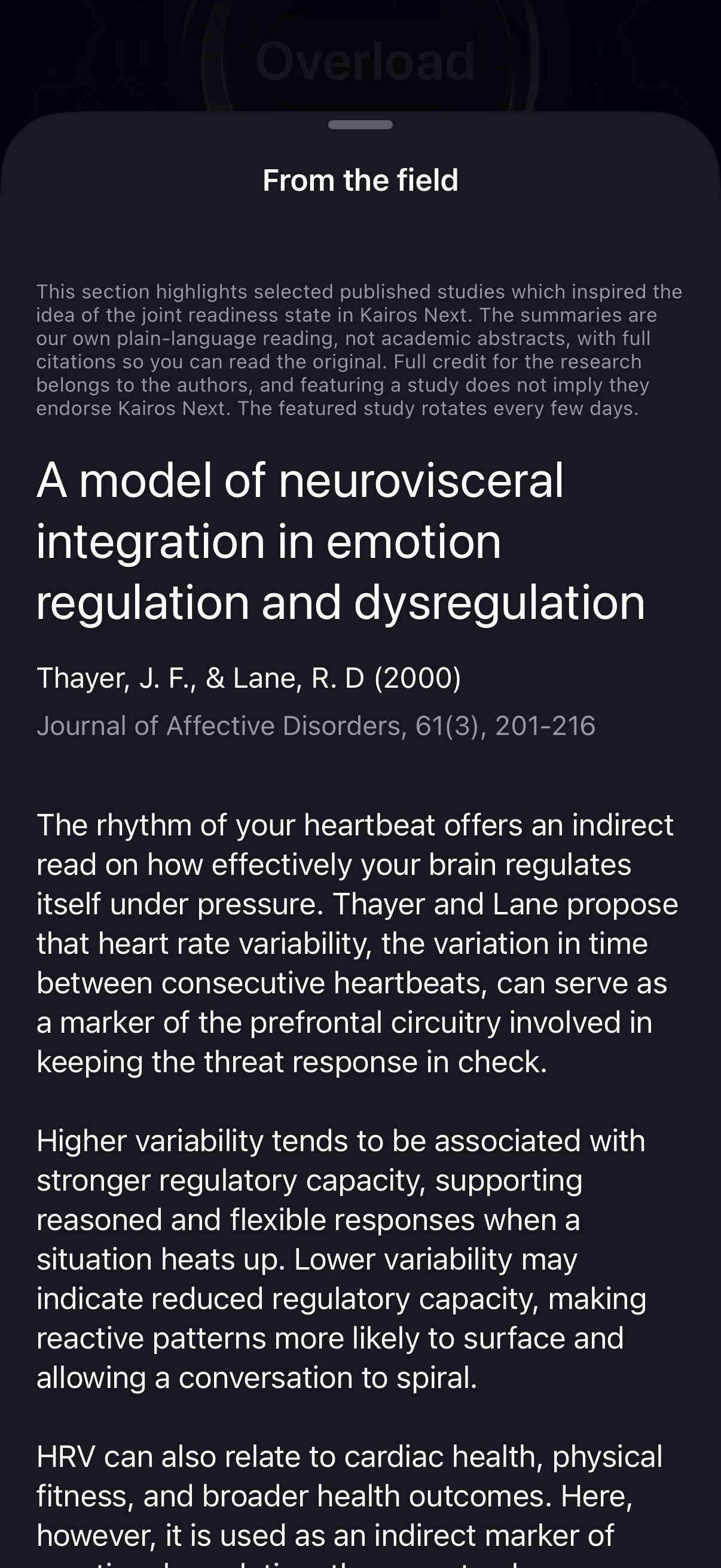
The research that inspired the joint state, summarised in plain language. The studies rotate periodically.
06 / The science
Established signals. A new way of bringing them together
30 married couples had low- and high-conflict interactions while their physiology was measured. Three years later, among the 19 couples followed up, higher physiological arousal during those early interactions predicted a larger decline in marital satisfaction. The study suggests that what happens in the body during conflict may play a role in how relationships change over time.
Levenson & Gottman · J. of Personality and Social Psychology ↗ 2007 The nervous systemPolyvagal theory proposes that the body supports different patterns of response: some states make social engagement easier, while others prepare us for defense. Measures such as respiratory sinus arrhythmia and heart rate variability can offer clues about regulation, even though they are not a simple readout of how someone feels.
Porges · Biological Psychology ↗ 2017 SynchronyAcross 61 studies, Palumbo et al. found that people's autonomic activity can become linked during interaction, often called physiological synchrony. Signals such as heart rate, respiration, and skin conductance can become correlated over time. The pattern depends on the context, the relationship, and how synchrony is measured, but the review supports the idea that physiology during interaction is partly shared, not only individual.
Palumbo et al. · Personality and Social Psychology Review ↗Kairos Next draws inspiration from published academic research but is independent of it. No affiliation or endorsement is implied. The exact application of Kairos Next is new and not yet directly studied.
07 / Privacy
Raw signals are read and processed on your phone. The server receives only a single derived value.
Your derived value is deleted after seven days.
No ads, no profiling, no selling of data.
For the joint state, yes. Pairing takes one scan and neither of you needs an account. On your own, Kairos Next reads your personal state.
Nothing. Everything the app does today is free. Paid functionalities may come later.
No. Without one, a short self check-in is enough. With one, the reading sharpens.
Anything that writes to Apple Health. Apple Watch is the best fit because it refreshes the heart rate variability through the day. Oura, Garmin, Whoop and Polar work through Apple Health too, though they tend to sync less often. No wearable at all is fine, a self check-in is enough.
Kairos Next shows only the joint state to both of you, and either of you can unpair at any time. On our side, the derived value exists briefly, tied to a random device code, never to you as a person.
The signals are well studied. The state is a consistent, meaningful read, not a clinical measurement. A compass, not a coordinate.
It might not be the words. It might be the moment
Kairos Next is on iPhone. Pair with the person who matters, and let the timing find you.